
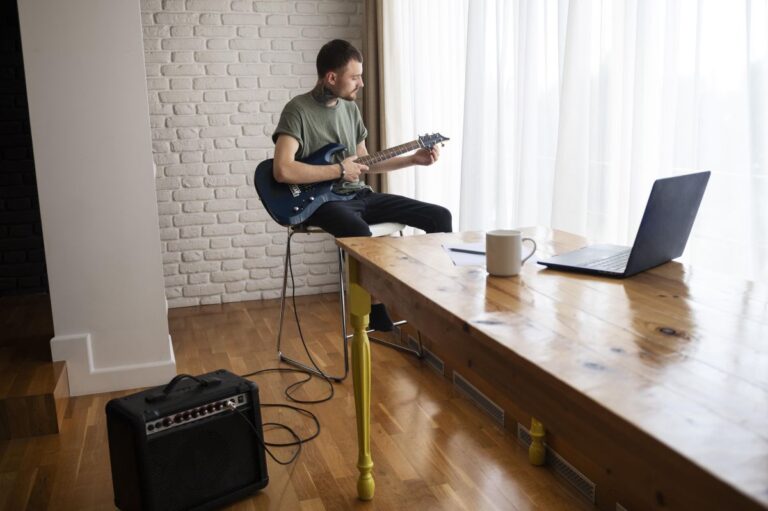
You finally have a spare room for your guitar, a small amplifier, and enough space to practice. Then comes the first complaint. Your neighbor can hear the same riff through the wall, even at a volume that seems reasonable inside your room.
The best way to create a quiet guitar practice room is to choose the right location, reduce amplifier volume, seal gaps around doors, and use headphones when necessary. Acoustic panels can improve the sound inside the room, but they cannot replace proper sound isolation.
I would start with the cheapest changes before spending money on new walls or expensive acoustic materials. A different amplifier position or a good pair of headphones may solve the problem.
Key Takeaways
- Acoustic panels reduce sound reflections inside a room. They do not provide substantial isolation through ordinary walls.
- A hollow-core door can weaken the sound isolation of an otherwise solid partition.
- Headphones are one of the most effective options for quiet electric guitar practice.
- A rug and amplifier isolation pad may reduce contact noise, but not all airborne sound.
- A simple test can identify the best room before any expensive work begins.
Choose the Quietest Room Before You Move Your Equipment
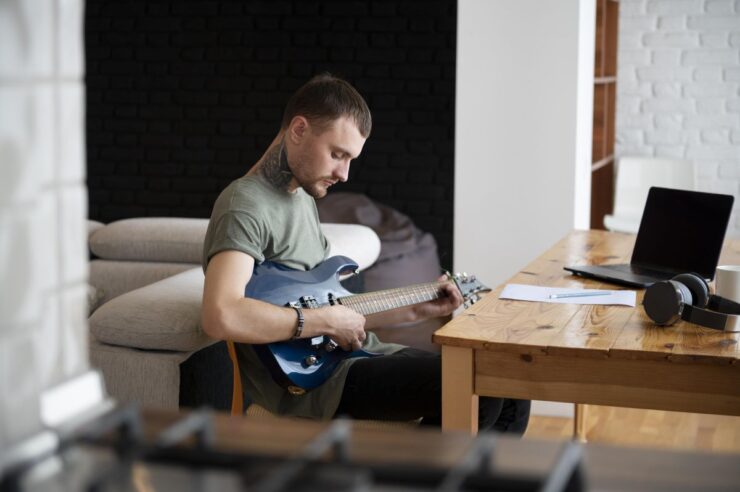
A spare bedroom may seem like the obvious choice for a guitar practice room. However, its location matters more than its size.
If the room shares a wall with your neighbor’s bedroom, sound can travel directly through the partition. A room next to a hallway or another part of your home may offer more separation.
I would compare the available rooms before buying anything.
| Room | Main advantage | Potential problem |
|---|---|---|
| Interior spare bedroom | More separation from exterior walls | Shared partitions may still transmit sound |
| Basement | Greater distance from nearby bedrooms | Vibration can travel through structural elements |
| Living room | More space for instruments | Less privacy and more disruption to the household |
An interior room is not automatically quieter. Construction, doors, floors, and the position of nearby apartments all affect the result.
For electric guitar practice, I would avoid placing the amplifier directly against a wall shared with a neighbor. Moving the cabinet away from that partition is worth testing, although no fixed distance guarantees a particular reduction in noise.
Test Two Rooms Before You Spend Money
You do not need a professional acoustic consultant for an initial comparison between two possible practice rooms.
Consider an illustrative example. A guitarist has a 10 × 12-foot spare bedroom beside a neighboring apartment and another room closer to the center of the house.
The simplest test uses the same guitar, amplifier, and musical passage in both rooms.
- Place the amplifier in the first room and set a modest, fixed volume.
- Play the same 30-second passage.
- Ask another household member to listen at a fixed location outside the room.
- Repeat the test in the second room without changing the amplifier settings.
- Compare how clearly the guitar can be heard at the listening point.
A neighbor’s cooperation may allow a more relevant comparison, but it should never be assumed.
A phone sound meter may help with rough comparisons. However, uncalibrated microphones, automatic processing, and different frequency responses can affect the results. Such measurements should not be presented as professional acoustic test data.
The example is a proposed test, not a documented personal experiment.
My preference would be the room that causes the least disturbance at a usable practice volume. Its size and appearance would come second.
Acoustic Panels Will Not Soundproof Your Guitar Room
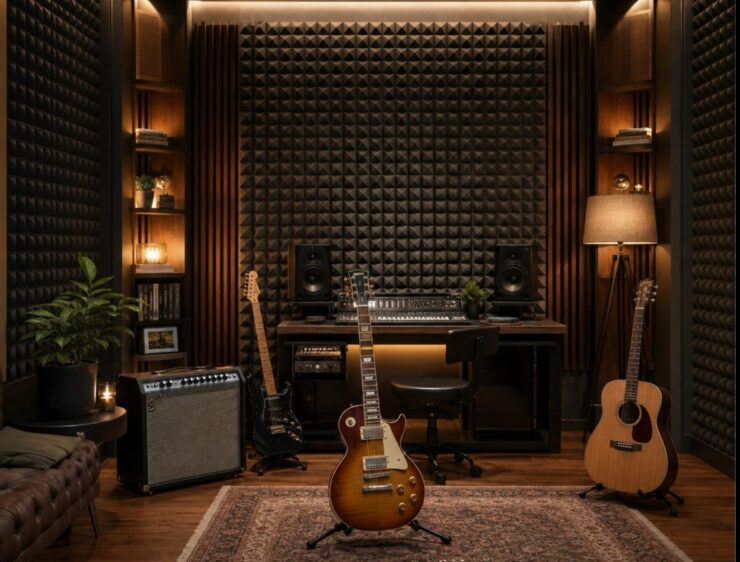
One of the easiest mistakes is to cover every wall with acoustic foam and expect the neighbors to hear less guitar.
The problem is that sound absorption and sound isolation are different.
According to the American Speech-Language-Hearing Association’s acoustic guidance, sound absorption describes how surfaces reduce reflected sound. Sound Transmission Class, or STC, describes the airborne sound isolation performance of a partition or building element.
For a guitar room, the difference is important.
| Material or improvement | Main purpose | Important limitation |
|---|---|---|
| Acoustic foam panels | Reduce some reflections inside the room | Little isolation through the wall |
| Thick rug and pad | Reduce floor reflections and some contact noise | Limited effect on airborne amplifier sound |
| Sealed solid-core door | Improve isolation at a common weak point | Wall and frame construction still matter |
| Isolated wall assembly | Reduce sound transmission | More expensive and requires suitable construction |
| Headphones | Avoid loud sound from an amplifier speaker | Acoustic string noise remains audible |
Acoustic panels are useful when a room sounds harsh or produces excessive echoes. They are not the first purchase I would recommend after a neighbor complains.
For a serious isolation problem, the construction needs professional assessment.
Fix Door Gaps Before You Invest in New Walls
The door is often the weakest part of a guitar practice room.
A hollow-core door may be light and convenient, but its limited mass and gaps around the frame can allow substantial sound transmission.
The Federal Highway Administration’s acoustic construction guide provides a useful technical example.
A typical hollow-core door has an STC rating of approximately 17. In the FHWA example, a door occupying 20% of a partition reduces the combined STC rating from 48 to 24.
The calculation demonstrates why one weak component can undermine a much stronger wall.
Before replacing the door, I would inspect its perimeter and lower edge.
Check for visible gaps, damaged seals, and loose fittings. Suitable perimeter seals or a properly fitted door sweep may help reduce sound leakage.
A solid-core door can offer better isolation, particularly with effective seals. The exact improvement depends on the entire door assembly.
Do not obstruct required ventilation, alter a fire-rated door without proper approval, or make permanent changes to a rented property without permission.
A well-sealed door is useful, but it cannot correct sound transmission through a ceiling, ventilation duct, or poorly constructed shared wall.
Control Amplifier Volume Before You Add Acoustic Materials
A powerful amplifier is rarely necessary for ordinary practice in a small room.
For electric guitar, I would prioritize equipment with a usable master-volume control and a dedicated headphone output.
Compact modeling amplifiers and digital amp simulators can produce a wide range of guitar sounds without a large speaker cabinet.
The main decision is how you practice.
For exercises and technique: Headphones or a suitable digital setup can keep speaker noise to a minimum.
For tone adjustment: A compact amplifier at moderate volume may be useful, provided the sound does not disturb nearby residents.
For acoustic guitar: The instrument produces sound without an amplifier. The best options are room choice, technique, and considerate practice hours.
An acoustic guitar’s body affects its natural sound and volume. Players who want to compare instrument styles can also read Melanco Guitars’ guide to left-handed acoustic guitars.
Headphones cannot silence an acoustic guitar’s strings or resonant body. Late-night acoustic practice may still be audible through a thin partition.
Do Isolation Pads Help?
An amplifier stand or isolation pad can reduce some direct vibration between a cabinet and the floor.
That can matter in an upstairs apartment with wooden floors.
However, an isolation pad cannot block the airborne sound from the speaker. Its effect also depends on the support surface, cabinet weight, and pad construction.
I would test the amplifier on a stable stand before buying an expensive isolation platform.
If the complaint concerns bass vibrations, the underlying problem may require a more detailed assessment of the floor structure.
Use Headphones Without Excessive Volume
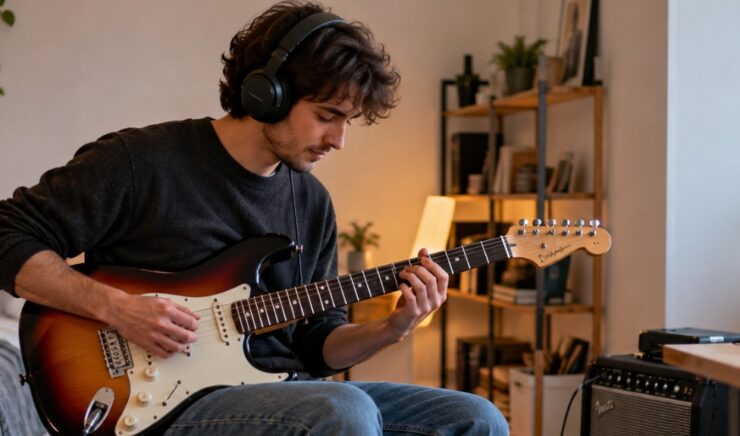
Headphones are particularly useful for electric guitar practice in apartments.
They also make it easy to listen at excessive volume without realizing it.
The National Institute for Occupational Safety and Health recommends an occupational exposure limit of 85 dBA averaged across eight hours. Its recommended exposure duration falls by half for every additional 3 dB.
For example, the occupational exposure duration drops to four hours at 88 dBA.
That guidance is designed for workplace noise assessment. It is not a guarantee of safe headphone use for every musician.
I would keep headphone volume moderate and avoid increasing it to compete with household noise.
Closed-back headphones can reduce some unwanted external sound, although their isolation performance varies.
For a dedicated electric guitar practice room, good headphones may offer more immediate value than several decorative acoustic panels.
Prepare Walls and Surfaces After Acoustic Repairs
A guitar room should also be comfortable, clean, and practical.
However, I would leave cosmetic wall improvements until after any necessary acoustic work.
A new door frame, repaired drywall joint, relocated electrical outlet, or wall-mounted support can leave visible surface damage. Repainting before such work may require another round of repairs.
My preferred order would be:
- Identify the main sound transmission problem.
- Complete any approved construction or door repairs.
- Repair drywall and prepare the affected surfaces.
- Apply the chosen interior finish.
- Install instrument racks and acoustic treatment.
For homeowners in Central Texas, Waco Texas Painters at Yellow Rose Painting provide interior painting services that may suit the final wall-preparation and decoration stage.
Ordinary decorative paint does not soundproof a room. Its role is to provide a durable finish after the necessary repairs.
I would choose a low-glare finish and position task lights to illuminate the fretboard or sheet music without direct reflections into the player’s eyes.
For wall-mounted guitar racks, verify the required supports and installation method. Decorative acoustic foam is not a suitable mounting surface.
Arrange the Room Around Your Practice Routine
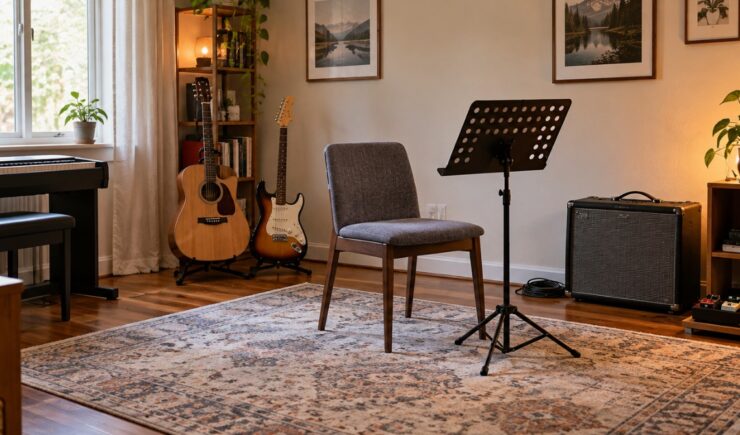
A practice room does not require a complicated layout.
A stable chair, music stand, guitar storage, and a convenient place for cables may be enough.
In a 10 × 12-foot room, I would start with the chair near an interior wall and place the amplifier away from the shared partition.
Keep guitar stands outside walking paths. Allow enough clearance for the guitar neck and your arms.
For players who also practice piano or keyboard, equipment needs can be quite different. Melanco Guitars’ article on guitar versus piano provides further context on the instruments and their practical differences.
If the room serves several instruments, keep the loudest practice setup away from the weakest partition whenever possible.
Avoid acoustic panels in locations where they obstruct ventilation, electrical equipment, or safe access to the door.
What Should You Fix First?
I would choose the next step based on the actual complaint rather than buy an entire collection of soundproofing products.
| Problem | First action | When additional work makes sense |
|---|---|---|
| Electric guitar is audible through the wall | Reduce amplifier volume or use headphones | Normal daytime practice still causes complaints |
| Room has excessive echo | Add appropriate absorptive panels | Reflections still affect the sound |
| Sound escapes around the door | Check seals and gaps | Door assembly remains a weak point |
| Vibration travels through the floor | Test a stable stand or suitable isolation pad | Structural transmission remains noticeable |
| Acoustic guitar bothers neighbors at night | Change practice hours or use quieter exercises | Daytime sessions also create problems |
If complaints continue despite source-volume control and simple repairs, a qualified acoustician can help identify the principal transmission path.
A wall upgrade may not help enough if most of the sound travels through a door, floor, or shared ventilation system.
A Good Practice Room Does Not Need to Be a Recording Studio
The goal is a reliable space for daily guitar practice, not perfect isolation at any cost.
Start with the quietest suitable room. Keep amplifier volume under control. Check door gaps and floor contact before major construction. Use acoustic panels for sound quality inside the room, not as a substitute for isolation.
Reasonable practice hours also matter. A short conversation with nearby residents can reveal a conflict that no acoustic panel would solve.
I would rather use a modest, well-organized room with sensible volume control than spend heavily on equipment that fails to address the actual noise problem.